

UK Mortgage Market Update: August 2026
Lenders are still competing, approvals have picked up and there are more than seven thousand residential products on the shelf. But mortgage rates on fixed deals edged higher through July even though Bank Rate did not move. Here is what the UK mortgage market means for you if you are buying, moving, remortgaging or letting.
- Average two-year fix 5.62%, five-year 5.66% at the end of July (Moneyfacts)
- Bank Rate held at 3.75% on 30 July, next decision 17 September
- 7,177 residential products available, average shelf life 14 days
- Around 1.8 million fixed rates are forecast to mature this year
broad range of UK lenders
Momentum Financial Services Ltd · FRN 1011740
a real adviser, start to finish
rates, fees & total borrowing
Tell Us About Your Mortgage
Rates are repricing quickly and the right answer depends on your deposit, your income and how long you plan to stay. Tell us where you are and we will give you a straight view of your options.
Mon–Fri 9am–5pm · Saturday by appointment
Enquiry Form
Tell us about your situation and we'll get back to you with tailored advice.
Where The Mortgage Market Stands
The UK mortgage market went into August with pricing moving the wrong way for borrowers. At the end of July 2026 the average two-year fixed rate stood at 5.62% and the average five-year fix at 5.66%, according to Moneyfacts. The average two-year tracker was 4.49% at the start of the month, and the average standard variable rate was 7.13%. Those are market-wide averages of advertised mortgage rates, not quotes, and very few borrowers actually pay the average. Moneyfacts averages every advertised product, so these figures run higher than the fee-standardised Podium averages used in our September update — the two sets are not directly comparable.
Two details in that list matter more than the headline numbers. The first is that the five-year average now sits above the two-year, which is unusual and tells you markets are not confident that rates fall quickly from here. The second is the gap between the tracker average and the standard variable rate: 4.49% against 7.13% is not a rounding difference, it is roughly £400 a month on a £250,000 mortgage.
Product choice is not the constraint. There were 7,177 residential mortgage products available at the start of July, including 913 at 90% loan to value and 450 at 95%. Lenders want the business. What has tightened is not supply but pricing and the speed at which it changes: the average product was on sale for just 14 days before being withdrawn or repriced.
That shelf life is the practical point for anyone mid-decision. A rate you were quoted a fortnight ago may simply no longer exist, and the version that replaced it may be priced differently. It is one of the reasons we would rather secure something and review it than watch and wait.
Why Fixed Rates Rose While Bank Rate Held
The Bank of England held Bank Rate at 3.75% on 30 July 2026. The vote was 6–3, and the three dissenters were not arguing for a cut: they wanted an immediate rise to 4.00%. That is a more hawkish committee than most commentary suggested at the start of the summer.
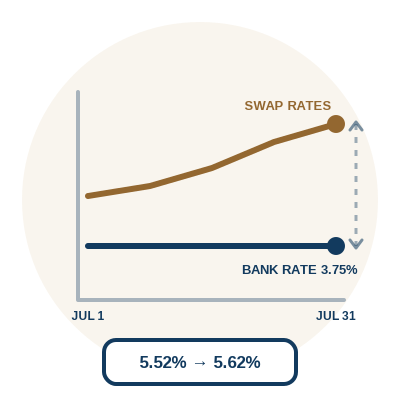
Fixed mortgage rates are not set by Bank Rate, though. Lenders price fixed products off swap rates, which reflect what markets expect interest rates to average over the next two, five or ten years, plus the cost of attracting deposits, the level of risk in the loan and how badly the lender wants volume that month.
Swap rates moved up through July as markets grew more concerned about inflation and energy prices, and lenders repriced accordingly. The average two-year fix went from 5.52% on 1 July to 5.62% by the end of the month. Bank Rate did not move at all in that period.
The corollary is worth holding on to: mortgage rates can also fall before the Bank cuts, if markets become convinced a cut is coming. Waiting for an official announcement usually means arriving after the pricing has already changed. The next decision is on 17 September 2026.
House Prices Are Moving In Different Directions
The average UK house price was £271,000 in May 2026, up 2.7% over the year. That single number hides almost everything interesting, because the national figure is the average of markets moving in opposite directions.
Northern Ireland was up 7.4% on a quarterly basis, the North East of England 5.9%, Scotland 4.4% and Wales 4.2%. London fell 3.7% over the year, and the split within London is sharper still: Inner London was down 5.9% while Outer London was broadly flat at −0.3%.
Affordability explains most of it. Where prices are a high multiple of local income, buyers need larger mortgages, and larger mortgages are more sensitive to a rate rise. Markets where a decent family home needs a £160,000 mortgage have absorbed the last few years far better than markets where the same house needs £450,000.
For anyone buying in London and the South East, the practical reading is that a softer market gives you more negotiating room than you have had in a while, but affordability testing is still the gate you have to get through. Those two things pull in opposite directions, and which one dominates depends entirely on your income and deposit.
Annual Change By Area
Read More On The Market
These are the pages people read alongside a market update, depending on which decision is in front of them.
Remortgage Advice
Coming off a fixed rate, raising capital, or moving away from your current lender.
First-Time Buyer Mortgages
Deposits, schemes and what lenders look for when you are buying your first home.
Buy to Let Mortgages
Rental cover, stress testing, and personal against company ownership compared.
Buyers And Remortgagors Are Still Transacting
Bank of England figures for June 2026 showed 58,200 mortgage approvals for house purchase, up from 56,600 in May, and 34,200 approvals for remortgaging with a different lender. Gross secured lending was £27.4 billion and net mortgage borrowing jumped to £7.7 billion, from £3.3 billion the month before.
That is not a frozen market. It is a market where people who need to move are moving, and people whose deals are ending are dealing with it, while discretionary buyers wait to see what September brings.
The remortgage number is the one we would watch. Thirty-four thousand people switching lender in a single month, at a point when switching usually means accepting a higher rate than the one they are leaving, tells you how many maturities are working through the system.
If you are in that group, the useful question is not whether the market is good. It is whether your particular lender, at your particular loan to value, with your particular income, will do better than the alternative. That is a question with an actual answer, and it takes about twenty minutes to get.
Why The Lowest Rate Is Not Always The Cheapest Deal
On a £250,000 repayment mortgage over 25 years, the monthly payment at 4.50% is about £1,390. At 5.62% it is about £1,554. At 6.50% it is £1,688, and at the 7.13% average standard variable rate it is £1,788. So the difference between a competitive fix and drifting onto SVR is roughly £398 a month, or £4,776 a year.
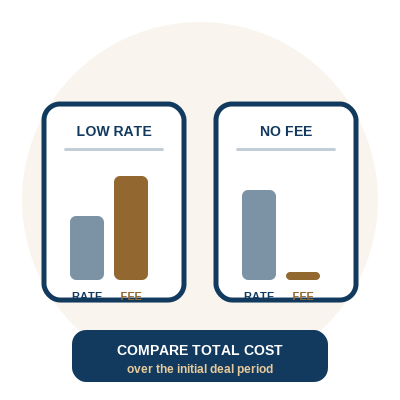
Those figures are illustrative and exclude fees, which is exactly where the comparison usually goes wrong. A product fee of £1,499 is 1.5% of a £100,000 mortgage before you have paid a penny of interest, and less than 0.2% of an £800,000 one. The same fee is punitive on one loan and trivial on another.
The consequence is that the cheapest advertised rate and the cheapest deal are frequently different products, and which is which depends on your balance. On a small mortgage, a product with no fee at a slightly higher rate very often wins. On a large one, buying the rate down with a fee usually does.
What actually matters is the total cost over the initial period: payments, plus fees, minus any cashback or free valuation, and with an eye on the reversion rate and any early repayment charge. Comparing two products on interest rate alone answers a question nobody asked.
If Your Fixed Rate Ends This Year
UK Finance forecast that around 1.8 million fixed-rate mortgages would mature during 2026. Most of those borrowers fixed when pricing was materially cheaper, so for a large share of them the new payment will be higher whatever they do. That is uncomfortable, but it is not a reason to delay, because the one genuinely bad outcome is doing nothing.
Doing nothing means lapsing onto the lender’s standard variable rate, currently averaging 7.13%. There is no version of the market in which that is the best available option, and it is the single most expensive mistake we see.
Start looking three to six months before your rate ends. That window gives you time to check what your existing lender will offer on a product transfer, compare that against switching, get a view on your property’s current value, tidy up your credit file and gather income evidence without rushing.
Many lenders will let you reserve a rate several months ahead, and most will let you switch to a cheaper product if pricing improves before completion. That combination gives you a floor without giving up the upside, which in a market repricing every fortnight is worth having.
First-Time Buyers And Home Movers
For first-time buyers the two obstacles are unchanged: assembling a deposit and passing an affordability assessment. Products exist at 95% and 90% loan to value, so a 5% or 10% deposit is workable, but each step down in loan to value moves you into better pricing. Getting from 5% to 10%, or 10% to 15%, is often worth more than shopping for a marginally better rate at the same band.
Budget beyond the deposit. Stamp duty where it applies, conveyancing, a survey, product and valuation fees, removals, buildings and contents insurance, and the repairs that reveal themselves in the first month. First-time buyer relief in England and Northern Ireland means no stamp duty on the first £300,000 and 5% between £300,001 and £500,000, with no relief at all above £500,000. Scotland and Wales have their own systems.
Home movers usually have more equity, which helps, but the sums can still be tight when the new mortgage is much larger than the old one. Early repayment charges, estate agent and legal fees, and the gap between your current rate and today’s pricing all need to be in the calculation before you commit to an asking price.
Porting an existing mortgage to a new property is often possible and often misunderstood. It is not a transfer that happens automatically: the lender reassesses affordability, reassesses the property, and prices any additional borrowing at today’s rates. Assume it needs a full application, because it does.
Buy To Let, Arrears And What Comes Next
Landlords advanced 58,272 new buy-to-let mortgages worth £10.8 billion in the first quarter of 2026. The split matters: remortgaging rose 11.1% year on year to 39,160 loans while purchase lending fell 14.9% to 16,871. Existing landlords are refinancing and staying; fewer new ones are arriving, deterred by stamp duty surcharges, the tax treatment of mortgage interest, compliance costs and rental stress tests.
On arrears, the numbers are steadier than the headlines suggest. There were 79,110 homeowner mortgages in arrears of 2.5% or more of the balance in the first quarter, 0.91% of all homeowner mortgages, and down 2% on the previous quarter. Possessions rose modestly to 1,250 homeowner cases, but more than two-thirds related to mortgages taken out at least a decade ago. This is a legacy tail, not a wave of new distress.
If you are struggling, speak to your lender early rather than late. A temporary move to interest only, a longer term or a revised payment date are all normal arrangements, and lenders would far rather agree one than pursue a possession. Each of those options reduces the monthly payment and increases what you pay overall, so they are tools for a rough patch rather than permanent fixes.
Looking ahead, a return to the 1% and 2% mortgage rates of 2021 is not on the table in any realistic scenario. Average fixed rates drifting into the high fours or low fives is a reasonable central case for the UK mortgage market if inflation continues to ease, but persistent inflation, an energy shock or higher gilt yields would keep them where they are. Plan around what you can afford now, not around a forecast.
We are based in Sevenoaks and advise clients across South East London and Kent, including Lewisham, Bromley and Sidcup. We are not limited to those areas: we work with clients right across the UK, including London, Essex, Surrey, Sussex, Hertfordshire and Buckinghamshire, and most cases are handled by phone and video, so where you live is rarely a barrier. You can also read our remortgage advice.
What To Do Now
If you take one thing from this update, make it a sequence rather than a prediction. This is the order we would work through it.
Check Your End Date
Find out exactly when your current rate ends and what the reversion rate is. If that date is inside six months, you are already in the window where action beats waiting.
Get Your Lender's Offer
Ask your existing lender what it will do on a product transfer. That is your baseline. Anything else has to beat it, and sometimes nothing does.
Establish Your Loan To Value
Property values have moved in both directions since you last borrowed. A revaluation can drop you into a cheaper band, or warn you that it will not.
Compare Total Cost, Not Rate
Payments plus fees, less incentives, across the initial period. On a smaller mortgage a product with no fee at a higher rate often wins outright.
Secure Something Early
Reserve a rate you are comfortable with. Most lenders let you switch down if pricing improves before completion, so you keep the floor and the upside.
Review Before Completion
Products last around a fortnight. We re-check yours before the case completes so you are not held to a rate the market has already moved past.
Not Sure What To Do About Your Rate?
Twenty minutes on the phone will tell you whether fixing, switching or holding is the right call for your circumstances. No cost, no obligation, no credit search.
Read our mortgage guide, view our frequently asked questions, or explore remortgage advice.
UK Mortgage Market Update: Frequently Asked Questions
Why did my mortgage rate go up when the Bank of England did not change Bank Rate?
Because fixed mortgage rates are not priced off Bank Rate. Lenders price fixed products using swap rates, which reflect what financial markets expect interest rates to average over the length of the deal, together with funding costs, risk and how much lending the lender wants. Swap rates rose through July 2026 on inflation and energy concerns, so lenders repriced upwards while Bank Rate stayed at 3.75%. The same mechanism works in reverse: fixed rates can fall before the Bank announces a cut.
Should I fix for two years or five years right now?
There is no universally right answer, and anyone who gives you one without asking about your circumstances is guessing. Two years suits people who expect to move, expect rates to fall, or want to revisit the decision sooner, at the cost of another set of fees and another round of uncertainty in 2028. Five years suits people who value knowing the payment, particularly if the budget is tight. The deciding factors are how long you will stay in the property, whether you can absorb a payment rise, and what the early repayment charges look like.
What happens if I do nothing when my fixed rate ends?
You move onto your lender’s standard variable rate, which averaged 7.13% at the end of July 2026. On a £250,000 mortgage over 25 years that is roughly £1,788 a month, against about £1,554 on a 5.62% fix — a difference of around £234 every month, or £2,800 a year. There is no scenario in which the standard variable rate is your best option, and it is the most expensive avoidable mistake in the market.
How far in advance should I start looking at a remortgage?
Three to six months before your current rate ends. That gives you time to see what your existing lender will offer, compare it against the wider market, get a view on your property’s value, check your credit file and gather income evidence without being rushed. Many lenders will let you reserve a product several months ahead and switch to a cheaper one if pricing improves before completion, so booking early costs you nothing and protects you against further increases.
Is it a bad time to buy a house?
It depends far more on your circumstances than on the market. Buying makes sense if the payments are comfortably affordable with room to spare, your income is stable, you have savings behind you, and you expect to be in the property for several years. It makes less sense if the numbers only work assuming rates fall. Waiting is not risk-free either: cheaper mortgages tend to bring more buyers into the market, which supports prices, so a lower rate later can be offset by a higher purchase price.
Why is the cheapest advertised rate not always the cheapest mortgage?
Because product fees change the arithmetic, and they change it differently depending on how much you are borrowing. A £1,499 fee is about 1.5% of a £100,000 mortgage and about 0.2% of an £800,000 one. On smaller balances a product with no fee at a slightly higher rate frequently costs less overall; on larger balances paying a fee to buy the rate down usually wins. The comparison that matters is total cost over the initial period, including fees and any cashback, not the headline rate.
Are lenders still lending, or has the market tightened?
Lenders are very much still lending. There were 7,177 residential mortgage products available at the start of July 2026, including 913 at 90% loan to value and 450 at 95%, and mortgage approvals rose to 58,200 in June. The constraint is not product availability, it is affordability assessment. Different lenders calculate income, commitments and expenditure differently, so the amount you can borrow can vary substantially between them even on identical circumstances.
Is a tracker mortgage worth considering while fixed rates are high?
It can be, but only if you could genuinely afford the payment if rates rose. The average two-year tracker was 4.49% against 5.62% for a two-year fix, so the starting payment is lower and it would fall further if Bank Rate is cut. It would also rise if Bank Rate went up, and three members of the Monetary Policy Committee voted for exactly that in July 2026. Before choosing one, work out what the payment becomes if the rate rises by one or two percentage points, and check the early repayment charges.
Have a different question? Get in touch or read our full mortgage FAQs.
 Written and reviewed by Osman Emin, CeMAP, mortgage and protection adviser · FCA register OCE01003 · Updated