

Mortgage Referral Partners
You are often the first person to hear that a client is buying, selling, refinancing or restructuring. We take that introduction and turn it into properly advised mortgage work, without you carrying any of the regulatory weight.
- A named adviser, not a call centre queue
- Straightforward and complex cases both welcome
- Your client contacted the same working day wherever possible
- You are told when the case completes
broad range of UK lenders
Momentum Financial Services Ltd · FRN 1011740
a real adviser, start to finish
rates, fees & total borrowing
Tell Us About A Referral Partnership
Tell us a little about your firm and the kind of clients you work with. We will come back to you with a straightforward way to introduce them, and answer any questions about how the arrangement would work in practice.
Mon–Fri 9am–5pm · Saturday by appointment
Enquiry Form
Tell us about your situation and we'll get back to you with tailored advice.
What a Referral Partnership Actually Involves
A referral partnership is deliberately simple. You tell your client that we exist, or you pass us their name and number with their permission. From that point the mortgage advice, the regulatory responsibility and the case management sit with us. You do not give mortgage advice, you do not recommend a product, and you do not take on any liability for the outcome of the application.
That distinction matters. Introducing someone to a mortgage broker is not, by itself, a regulated activity, provided you stop at the introduction. The moment a conversation drifts into advising on which mortgage to take or arranging one, it stops being an introduction. If your firm wants to go beyond passing on contact details, that needs either direct authorisation or an appointed representative arrangement with a principal firm, and we will always say so rather than let a partner drift over the line by accident.
In practice, most of our partners never need to think about any of that. They mention us when a client raises borrowing, they send an email, and we take it from there. What they get back is a client who has been looked after and a transaction that keeps moving.
We work with firms of every size, from sole practitioners to multi-office practices. There is no minimum volume, no exclusivity clause, and no contract that ties you in. If the service is not good enough, you stop referring.
If you are an employer rather than an adviser, we also offer mortgage support for your employees, from workplace sessions to one-to-one appointments.
Accountants: Clients Whose Income Does Not Fit the Box
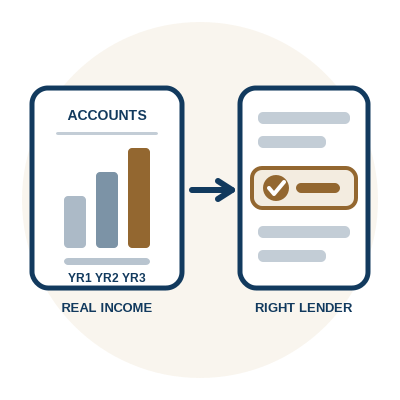
Accountants send us the cases high street lenders find hardest to read. Directors who pay themselves a small salary and take the rest as dividends. Sole traders whose most recent year is far stronger than the two before it. Partners in an LLP. Clients who want to borrow against retained profit rather than drawn income. Contractors working through a limited company on a day rate.
None of that is unusual to us, but it is unusual to an automated affordability calculator. Lenders differ enormously in how they treat this income. Some average the last two years, some use the latest year, some will work from an accountant’s projection, and a handful will lend against share of net profit rather than salary and dividends. Knowing which lender does what is most of the job.
What we ask from you is straightforward: the last two or three years of figures in whatever format you already produce them, once the client has agreed. What you get back is a client who has been told honestly what is achievable, rather than one who has applied to their own bank, been declined on a rigid income rule, and picked up a credit search for the trouble.
Your professional body’s ethical code will require you to tell your client about any referral fee or commission you receive from an arrangement like this. We will always confirm in writing what, if anything, is payable, so that disclosure is easy for you to make accurately.
Estate Agents: Buyers Who Can Actually Proceed
An agreement in principle from a comparison site tells you very little. It does not confirm that the deposit exists, that the income has been evidenced, or that the buyer has understood what their monthly payment will be. We would rather qualify a buyer properly before they offer than watch a sale fall through at week seven.
When you refer a buyer to us, we establish what they can genuinely borrow, what deposit is available and where it is coming from, and whether there is anything in their credit file or employment history that will need working around. If there is a problem, you find out early, while the property is still marketable, rather than after the survey.
We also keep you informed. With the client’s consent we will tell you when the application has gone in, when the valuation is booked and when the offer is issued. You are not left chasing a broker who will not return calls, and neither is your vendor.
On disclosure, the rules for agents are more prescriptive than for other professions. National Trading Standards guidance requires referral fee information to be given to buyers and sellers in advance of any transaction-based decision, in writing, naming the provider, stating the monetary value of the fee, and making clear that the consumer is free to use someone else. We will give you everything you need to meet that in full.

The Pages Your Clients Ask About Most
If you would rather send a client a link than explain it yourself, these are the ones worth bookmarking.
Self-Employed Mortgages
One, two or three years of accounts, and which figure lenders actually work from.
Buy to Let Mortgages
Rental cover, stress testing, and personal against company ownership compared.
Mortgages for Contractors
Day rate assessment rather than years of accounts, where the lender allows it.
Buy to Let Investment Guide
Yields, stress tests and the numbers behind a rental that actually works.
Conveyancers and Solicitors: Keeping the Chain Moving
Conveyancers see the damage a slow or unresponsive broker does. Requisitions go unanswered, the mortgage offer arrives with conditions nobody has read, the offer expires before exchange, and the whole file has to be reworked. Most of that is avoidable with a broker who answers the phone.
We aim to respond to a solicitor’s query the same working day, and we will speak directly to your file handler rather than routing everything back through the client. Where a lender’s offer carries conditions that affect the legal work, we flag them when the offer is issued instead of leaving you to find them.
We also handle the cases that arrive mid-transaction: a buyer whose lender withdraws, a client whose circumstances change between offer and exchange, a transfer of equity that needs a new lender, or a purchase that has to switch to bridging to complete on time. These are the moments where having a broker on the end of a phone is worth more than a panel arrangement.
If your firm is regulated by the SRA, section 5 of the Code of Conduct requires you to tell clients about any financial interest you have in referring them on, to disclose any fee-sharing arrangement relevant to their matter, and to have that agreement in writing. We are used to working within those requirements and will put anything you need in writing without being chased.
Referral Fees, Disclosure and Staying On The Right Side Of It
Referral arrangements are perfectly legitimate. What causes problems is silence about them. Every professional body that governs our partners takes broadly the same line: the client must know that you have an interest in sending them to us, and they must know they are free to go elsewhere.
Our approach is to make that easy. Whatever is agreed between us is confirmed in writing before the first referral, in terms plain enough to be repeated to a client. If an arrangement changes, you get that in writing too. Nothing is verbal and nothing is assumed.
Some partners prefer not to take a fee at all, and refer purely because they want the client looked after. That is entirely fine and, for some firms, considerably simpler. The quality of service your client receives does not change either way.
We are also happy to speak to your compliance officer or professional body directly if that helps you get an arrangement signed off. We would far rather spend an hour on that at the start than have a partner discover a problem two years in.
The Clients Worth Sending Our Way
There is no case type we would rather you filtered out before referring. If you are not sure whether something is workable, send it and let us tell you. A five minute conversation costs nothing and often turns up an option the client did not know existed.
That said, the introductions that tend to be most valuable are the ones where a high street lender has already said no, or where the client has not yet realised that their situation is unusual. A director whose accounts have just been finalised, a landlord whose fixed rate ends in six months, a buyer who has been told their contract type is a problem, or someone who has had a default fall off their file and assumes they are still excluded.
We advise across residential and investment lending, and we can also arrange the protection that lenders increasingly expect to see alongside a mortgage. Where a case genuinely is not viable, we will say so plainly and explain what would need to change, rather than keep a client hanging.
Referrals reach us however suits you: an email, a phone call, or simply giving the client our number and telling them to say who sent them.
We are based in Sevenoaks and work with professional firms across South East London and Kent, including Lewisham, Bromley and Sidcup. We are not limited to those areas: we take referrals from firms right across the UK, including London, Essex, Surrey, Sussex, Hertfordshire and Buckinghamshire, and most cases are handled by phone and video, so distance is rarely a barrier. You can also read more about how we work.
Cases We Take On
How Our Referral Process Works
Introducing a client should take you a couple of minutes, not an afternoon. This is what happens either side of that.
We Agree How It Will Work
A short conversation about the clients you see, how you would prefer to introduce them, and what, if anything, is payable. Everything agreed goes to you in writing before the first referral.
You Make The Introduction
Email us the client’s name and number with their permission, or simply give them ours and tell them to mention your firm. There is no portal to log into and no form to complete.
We Contact The Client
We aim to make contact the same working day. The first call establishes their circumstances, their objectives and their timescale, and sets expectations honestly about what is achievable.
We Research The Market
We compare lender criteria as well as rates, because on a non-standard case criteria is what decides the outcome. The client gets a recommendation with the reasoning explained.
We Run The Application
We package the case properly, submit it, chase the lender and deal with underwriter queries. Where you need updates, and the client has consented, you get them without asking.
You Hear How It Ended
We tell you when the offer is issued and when the case completes, so you are never left wondering whether the client you sent us was actually looked after.
Mortgage Referral Partners: Frequently Asked Questions
Do I need to be FCA authorised to refer clients to you?
Not to make a simple introduction. Passing on a client’s contact details, with their permission, and leaving all advice and arranging to us is not itself a regulated activity. What you must not do is advise the client on which mortgage to take, recommend a specific product or lender, or help arrange the mortgage yourself. If your firm wants to do more than introduce, that requires either direct FCA authorisation or an appointed representative arrangement with a principal firm, and we will tell you plainly if a conversation is heading that way.
Is there a referral fee, and how does disclosure work?
That depends on the arrangement we agree, and some partners choose not to take a fee at all. Whatever is agreed is confirmed to you in writing before the first referral, in language plain enough to repeat to a client. Your own professional body will almost certainly require you to disclose any fee or commission you receive to the client, and the rules for estate agents are particularly prescriptive, so we make sure you have the exact figures and wording you need to make that disclosure accurately.
How quickly will you contact a client I refer?
We aim to make contact the same working day, and in practice most referrals are called within a few hours. If a client is referred late in the day or over a weekend, they will hear from us the next working morning. If speed is critical, for example a buyer who needs to offer before a closing date, tell us when you refer and we will prioritise accordingly.
Will I be told what happens to the case?
Yes, where the client has consented to us sharing that. We will confirm that contact has been made, tell you when the application has been submitted, flag anything that is likely to delay the transaction, and let you know when the mortgage offer is issued and when the case completes. We will not share the detail of a client’s finances with you, only the case progress that is relevant to your role.
Is there a minimum number of referrals or a contract?
No. There is no minimum volume, no exclusivity requirement and no tie-in. Some of our partners refer several clients a month, others send us two cases a year. The arrangement is written down so that everyone is clear on how it works, but it is not a commitment to send us anything.
What if the client is not viable, or already has a broker?
If a case is not viable we will tell the client plainly, explain what would need to change and roughly how long that might take, and leave the door open. We do not string people along, because that reflects on you as much as on us. If a client already has a broker they are happy with, we will say so and step back rather than compete for the case.
Can you help clients outside South East London?
Yes. We are based in Sevenoaks and a good proportion of our work is local, but we advise clients across the UK and most cases are handled entirely by phone, video and email. If your firm operates elsewhere, or your clients are buying outside your own area, that is not a barrier to referring them.
Do you take on cases that another broker has already declined?
Frequently, and they are often among the most useful referrals we receive. A case that has been declined usually failed on a specific lender’s criteria rather than on the merits of the borrower, and a different lender may have no issue with it at all. It helps if we know what has already been tried and where it fell down, so we do not repeat a credit search that has already been used.
Have a different question? Get in touch or read our full mortgage FAQs.